



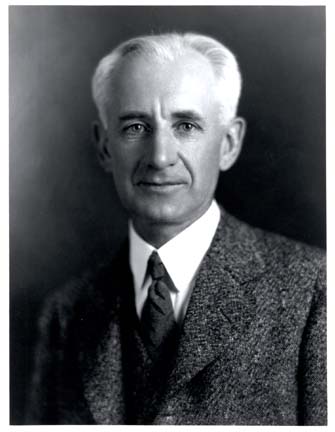
Robert Mearns Yerkes (May 26, 1876–February 3, 1956) worked in the field of comparative psychology. He is best known for studying the intelligence and social behavior of gorillas and chimpanzees. Joining with John D. Dodson, Yerkes developed the Yerkes-Dodson law relating arousal to performance.
Yerkes received his bachelor's degree from Harvard University in 1898. He received his Ph.D. in psychology from Harvard in 1902. He then became an instructor and later a professor at Harvard. In 1917, he served as president of American Psychological Association. Under his urging, the APA began several programs devoted to the war effort in World War I. Yerkes, as chairman of the Committee on the Psychological Examination of Recruits, developed the Army's Alpha and Beta Intelligence Tests, given to over 1 million United States soldiers during the war. The test ultimately concluded that recent immigrants (especially those from Southern and Eastern Europe) scored considerably lower than older waves of immigration (from Northern Europe), and was used as one of the eugenic motivations for harsh immigration restriction (the results would later be criticized as very clearly only measuring acculturation, as the test scores correlated nearly exactly with the number of years spent living in the USA).
In 1924, Yerkes was hired as a professor at Yale University. He founded the Yale University Laboratories of Primate Biology in Orange Park, Florida with funds from the Rockefeller Foundation and Carnegie Foundation. After Yerkes death, the lab was moved to Emory University in Atlanta, Georgia and is now called the Yerkes National Primate Research Center. The primate language Yerkish was developed there.