



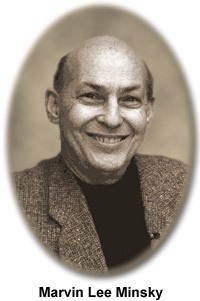
Marvin Lee Minsky (born August 9, 1927), sometimes affectionately known as "Old Man Minsky", is an American scientist in the field of artificial intelligence (AI), co-founder of MIT's AI laboratory, and author of several texts on AI and philosophy.
He was born in New York, where he attended The Fieldston School and Bronx High School of Science. He later attended Phillips Academy, in Andover, Massachusetts. He served in the US Navy in 1944-45. He holds a BA in Mathematics from Harvard (1950) and a PhD in the same field from Princeton (1954). He has been on the MIT faculty since 1958. He is currently Toshiba Professor of Media Arts and Sciences, and Professor of electrical engineering and computer science, at the Massachusetts Institute of Technology.
He has been awarded many honors. He is a member of both the U.S. National Academy of Engineering and the National Academy of Sciences. He won the Turing Award in 1969, the Japan Prize in 1990, and the Benjamin Franklin Medal in 2001.
Minsky's patents include the first head-mounted graphical display (1963) as well as the confocal scanning microscope (a predecessor to today's widely used confocal laser scanning microscope) and, jointly with Seymour Papert, the first Logo "turtle". Minsky also built, in 1951, the first randomly wired neural network learning machine, SNARC.
He wrote the book Perceptrons (with Seymour A. Papert), which became the foundational work in the analysis of artificial neural networks. Its criticism of unrigorous research in the field has been claimed as being responsible for the virtual disappearance of artificial neural networks from academic research in the 1970s.
Minsky was an adviser on the movie 2001: A Space Odyssey and is referred to in the movie and book,
"Probably no one would ever know this; it did not matter. In the 1980s, Minsky and Good had shown how neural networks could be generated automatically - self replicated - in accordance with any arbitrary learning program. Artificial brains could be grown by a process strikingly analogous to the development of a human brain. In any given case, the precise details would never be known, and even if they were, they would be millions of times too complex for human understanding."
During filming, Minsky was almost killed due to an accident, but survived.
Minsky is an actor in an artificial intelligence koan (attributed to his student, Danny Hillis) from the Jargon file:-
In the days when Sussman was a novice, Minsky once came to him as he sat hacking at the PDP-6.
"What are you doing?", asked Minsky.
"I am training a randomly wired neural net to play Tic-tac-toe" Sussman replied.
"Why is the net wired randomly?", asked Minsky.
"I do not want it to have any preconceptions of how to play", Sussman said.
Minsky then shut his eyes.
"Why do you close your eyes?", Sussman asked his teacher.
"So that the room will be empty."
At that moment, Sussman was enlightened.
Selected works
"Neural Nets and the Brain Model Problem," Ph.D. dissertation,
Princeton University, 1954. The first publication of theories and theorems
about learning in neural networks, secondary reinforcement, circulating
dynamic storage and synaptic modifications.
Computation: Finite and Infinite Machines, Prentice-Hall, 1967. A standard
text in Computer Science. Out of print now, but soon to reappear.
Semantic Information Processing, MIT Press, 1968. This collection had
a strong influence on modern computational linguistics.
Perceptrons, (with Seymour A. Papert), MIT Press, 1969 (Enlarged edition,
1988).
Artificial Intelligence, with Seymour Papert, Univ. of Oregon Press, 1972.
Out of print.
Robotics, Doubleday, 1986. Edited collection of essays about robotics,
with Introduction and Postscript by Minsky.
The Society of Mind, Simon and Schuster, 1987. The first comprehensive
description of the Society of Mind theory of intellectual structure and
development. See also The Society of Mind (CD-ROM version), Voyager, 1996.
The Turing Option, with Harry Harrison, Warner Books, New York, 1992.
Science fiction thriller about the construction of a superintelligent
robot in the year 2023.