



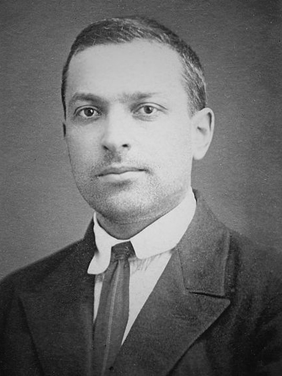
Lev Semyonovich Vygotsky (November 17 (November 5 (O.S.)), 1896—June 11, 1934) was a Russian developmental psychologist, discovered by the Western world in the 1960s. Vygotsky pioneered the notion that the intellectual development of children is a function of human communities, rather than of individuals. Within the fields of developmental psychology, education, and child development, his contributions are widely considered to be both paramount and well ahead of his time.
Biography
Lev Vygotsky was born in Orsha, Russian Empire (now in Belarus) to a Jewish family and grew up in Homel. He won a lottery for the Jewish quota for higher education and studied law and medicine in the First State Moscow University (1913-1917). He returned to Homyel, but was invited to Moscow in 1924.
In 1934 he had an acute attack of chronic tuberculosis and died at the age of 37.
Work
Vygotsky's work includes several key concepts which have been influential in the field of early childhood development. One of his most important concepts is the Zone of Proximal Development (ZPD) which relates to the gap or difference between what the child can learn unaided and what he or she can learn with the help of an adult or a more capable peer. The ZPD is therefore all the child can achieve when given appropriate support. Vygotsky believed that children could perform and achieve more difficult problems when they were guided and supported by another competent individual, generally an adult. This idea is known as scaffolding.
Children can either be at their actual development level, or their potential development level, depending on the amount of help they are receiving. When children are performing tasks without help from another person they are said to be at their actual development level. Potential development level is the level of competence a child can reach when he or she is guided and supported by another person.
This concept was later developed by Jerome Bruner and influenced Bruner's related concept of instructional scaffolding. Another important Vygotskyan contribution relates to the development of language as related to thought. This concept is explored in his brilliant book "Thought and Language" in which Vygotsky establishes the explicit and profound connection between oral language (speech) and the development of concepts (mental constructs) and one's conscious awareness of them--providing the underlying theoretical rationale for such truisms as "If you want to learn something, teach it to someone." And for the observation that by "talking it out" we clarify an issue in our own minds.
Vygotsky's model of human development has been termed as a sociocultural approach. For him, the individual’s development is a result of his or her culture. Development, in Vygotsky´s theory, applies mainly to mental development, such as thought, language and reasoning processes. These abilities were understood to develop through social interactions with others (especially parents) and therefore represented the shared knowledge of the culture. These abilities are developed through a process called internalization. Internalization describes how children’s social activities develop to become mental activities. When children listen and participate with parents, teachers, and peers, they begin to internalize and process new information.
Vygotsky's work appeared largely forgotten after his death, and his work in early cognitive development does not appear to have influenced cognitive developmentalists such as Jean Piaget. However, early - albeit indirect - influence on growing cognitive science community in the United States was already apparent in the late 1950s and early 1960s through the work of Vygotsky's student and later collaborator Alexander Luria which was read by early pioneers of cognitive science J. S. Bruner and George Miller.
By the 1980s, Vygotsky's work became well known in the United States in part due to the opening of the Soviet Union due to glasnost. Vygotsky's work became extremely influential because it offered a way of reconciling the competing notions of maturation by which a child is seen as an unfolding flower best left to develop on his or her own, and behaviourism, in which a child is seen as a blank slate onto which must be poured knowledge. His views are influential on activity theory, distributed cognition, and Cognitive Apprenticeships.
Works of Vygotsky are also studied today by linguists regarding language and its influence on the formation of the perception of reality.