



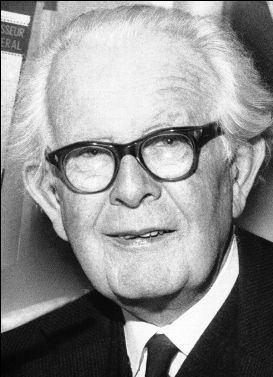
Jean Piaget (August 9, 1896 – September 16, 1980) was a Swiss developmental psychologist, famous for working out a sequence of stages of cognitive development, and notable for his idea that children (and indeed adults) are continually generating theories about the external world (which are kept or dismissed depending on whether we see them working or not in practice).
Biography
Early life:
He was born in Neuchâtel in the French-speaking part of Switzerland.
His father, Arthur, was a professor of medieval literature at the University
of Neuchâtel. He was a precocious child and developed an interest
in biology, particularly of mollusks, to the point of publishing a number
of papers before he graduated from high school. His long scientific career
began in 1907 at the age of eleven with the publication of a short paper
on the albino sparrow. Over the next seven decades he wrote more than
sixty books and several hundred articles.
He received a Ph.D. in natural science from the University of Neuchâtel and studied briefly at the University of Zürich. During this time, he published two philosophical papers which showed the direction of his thinking at the time, but which he later dismissed as adolescent work. His interest in psychoanalysis can also be dated to this period.
He then moved from Switzerland to France, where he taught at the school for boys run by Alfred Binet, the developer of the Binet intelligence test, in Grange-aux-Belles. In 1921, he returned to Switzerland as director of the Rousseau Institute in Geneva.
In 1923, he married Valentine Châtenay, and they had three children, whom he studied from infancy.
The Stages of Cognitive Development:
Piaget became a professor of psychology at the University of Geneva from
1929 to 1975 and is best known for organizing cognitive development into
a series of stages-- the levels of development corresponding to infancy,
childhood, and adolescence. These four stages are labeled the Sensorimotor
stage, which occurs from birth to age two, (children experience through
their senses), the Preoperational stage, which occurs from ages two to
seven (motor skills are acquired), the Concrete operational stage, which
occurs from ages seven to eleven (children think logically about concrete
events), and the Formal Operational stage, which occurs after age eleven
(abstract reasoning is developed here). Advancement through these levels
was explained through biology and culture along with a "third factor"
called equilibration, working inter-dependently with the other two.
Piaget's view of the child's mind:
Piaget viewed children as little philosophers and scientists building
their own individual theories of knowledge. Some people have used his
ideas to focus on what children cannot do. Piaget however used their problem
areas to help understand their cognitive growth and development. For example
children may not be able to conserve five checkers spread out and report
that there are more checkers. If you reduce the number to three they could
conserve numbers. By focusing on the fact they cannot conserve numbers
for five items you would be slow to pick up that they can do it for lower
numbers. Another surprise is if you tell them a magic bunny moved the
objects they would conserve higher numbers. Most people miss that children
are theoretical. But many children have imaginary playmates and love to
play the game of let's pretend.
Influence:
Piaget's theory of cognitive development has proved influential, notably
on the work of Lev Vygotsky and of Lawrence Kohlberg. Among others, the
philosopher and social theorist Jürgen Habermas has incorporated
it into his work, most notably in The Theory of Communicative Action.
Piaget also had a considerable impact in the field of computer science
and artificial intelligence. Seymour Papert used Piaget's work while developing
the Logo programming language. Alan Kay used Piaget's theories as the
basis for the Dynabook programming system concept, which was first discussed
within the confines of the Xerox Palo Alto Research Center, or Xerox PARC.
These discussions led to the development of the Alto prototype, which
explored for the first time all the elements of the graphical user interface
(GUI), and influenced the creation of user interfaces in the 1980's and
beyond. The philosopher Thomas Kuhn credited Piaget's work in helping
him understanding the transition between modes of thought which characterised
his theory of paradigm shifts.
Major works and achievements:
Single "best read" - Bringuier, J-C. (1980). Conversations with Jean Piaget. Chicago: University of Chicago Press.
Major Works:
- Inhelder, B. and J. Piaget (1958). The Growth of Logical Thinking from Childhood to Adolescence. New York: Basic Books.
- Piaget, J. (1962). Play, Dreams and Imitation in Childhood. New York: Norton.
- Piaget, J. (1970). Structuralism. New York: Harper & Row.
- Piaget, J. (1971). Biology and Knowledge. Chicago: University of Chicago Press.
- Piaget, J. (1983). Piaget's theory. In P. Mussen (ed). Handbook of Child Psychology. 4th edition. Vol. 1. New York: Wiley.
- Piaget, J. (1995). Sociological Studies. London: Routledge.
- Piaget, J. (2000). Commentary on Vygotsky. New Ideas in Psychology, 18, 241-59.
- Piaget, J. (2001). Studies in Reflecting Abstraction. Hove, UK: Psychology Press.
Appointments:
- 1921-25 Research Director, Institut Jean-Jacques Rousseau, Geneva
1925-29 Professor of Psychology, Sociology and the Philosophy of Science, University of Neuchatel - 1929-39 Professor of the History of Scientific Thought, University of Geneva
- 1929-67 Director, International Bureau of Education, Geneva
- 1932-71 Director, Institute of Educational Sciences, University of Geneva
- 1938-51 Professor of Experimental Psychology and Sociology, University of Lausanne
- 1939-51 Professor of Sociology, University of Geneva
- 1940-71 Professor of Experimental Psychology, University of Geneva
- 1952-64 Professor of Genetic Psychology, Sorbonne, Paris
- 1955-80 Director, International Centre for Genetic Epistemology, Geneva
- 1971-80 Emeritus Professor, University of Geneva