

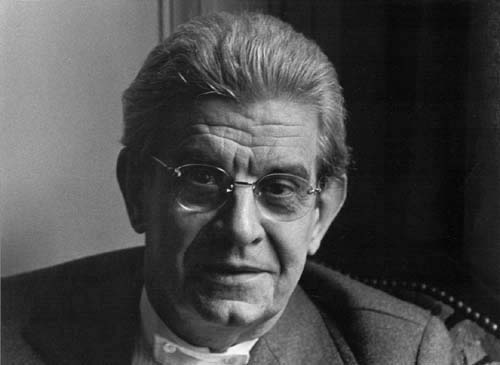
| Jacques Lacan
Jacques-Marie-Émile Lacan (April 13, 1901 – September
9, 1981) was a French psychoanalyst and psychiatrist. His clinical
theory is rooted in the work of Sigmund Freud, and derives from
linguistic sources (Ferdinand de Saussure), philosophical sources
(Kojève on Hegel), as well as mathematical sources (René
Thom, Nicolas Bourbaki, and topological theory of knots).
His central contribution to clinical (psychiatric, psychological,
psychotherapeutic) theory was the assertion that language, the spoken
language of the human subject, creates the subject. From this understanding
Lacan develops his study of psychoanalysis and his treatment strategies.
His work, while controversial, continues to influence the development
of psychoanalysis worldwide. In France and elsewhere various "schools"
of Lacanian thought have emerged. Although there exist various competing
emphases on Lacan's work among these "schools", all agree
in the fundamental importance of the unconscious. By structuring
the options available to any speaking subject in the articulation
of his or her desires, the unconscious determines the very fabric
of human life as we may come to know it, according to Lacan.
Life
Lacan's life is summarised in a timeline at this page.
Work
Lacan reiterated and clarified Sigmund Freud's findings. In contrast
to the dominant Anglo-American ego-psychologists of his time, he
considered the ego as constituted in the "other", rather
than an internal wholeness. After having obtained a medical degree
in psychiatry he settled in Paris, where he worked as a psychoanalyst,
primarily with patients suffering from various forms of psychoses.
Lacan argued that the psychoanalytic movement towards understanding
the ego as an active and dominating force in the self misinterpreted
its Freudian roots. Lacan stated that the self remained in eternal
internal conflict and that only extensive self-deceit made the situation
bearable.
Lacan also initiated the ideas of the Real, the Imaginary, and
the Symbolic, with which he explained the three aspects of human
psychic structure. Describing the interaction of this triad, Lacan
revised orthodox Freudian ideas about a stable psychic reality.
Lacan's notion of the Real is a very difficult concept which he
in his later years worked to present in a structured, set-theory
fashion, as mathemes. The Imaginary, or non-linguistic aspect of
the psyche, formulates human primitive self-knowledge while the
Symbolic, his term for linguistic collaboration, generates a community-wide
reflection of primitive self-knowledge and creates the very first
set of rules that govern behavior.
His developmental theory of the objectified self was inspired by
Ferdinand de Saussure's insights into the relationship of the signifier
and the signified.
Although Lacan has joined Freud and Melanie Klein as one of the
three major figures in the history of psychoanalysis, he made his
most significant contributions not in the traditional form of books
and journal articles, but through seminar lectures. The Seminar
of Jacques Lacan, conducted over a period of more than two decades,
was not simply transcribed by Jacques-Alain Miller, his son-in-law;
Sherry Turkle further claims that Lacan effectively contracted out
all work on the seminars to Miller after reviewing his work on the
first and that Miller made extensive changes to the seminars to
add clarity to the material (Turkle, Psychoanalytic Politics: Jacques
Lacan and Freud's French Revolution, p. 254-255). The Seminars are
still taken to represent the main body of his thinking. The Seminars
may be taken as more intellectually accessible than his published
collection of writings, entitled Écrits. Seminar XX remarks
that his Écrits were not to be understood, but would produce
a meaning effect in the reader similar to some mystical texts. Given
the complex provenance of these texts, this remark is extremely
difficult to evaluate.

The 'Return to Freud'
Within the work of Freud, there exists a deep theoretical ambiguity.
In the formative years of his career, he had been influenced by
the deterministic thought of Hermann von Helmholtz, and throughout
his life he continued to believe that psychoanalysis' discoveries
would be supported by neurology and physiology. However, in spite
of this commitment to determinism in the realm of the psyché
and his inclination towards biological modes of causal explanation,
Freud's analytical pratice was grounded in the interpretive understanding
of human speech. The balance between the determinstic and hermeneutical
aspects of Freud's thought proved too unstable to maintain for his
followers, and with Jung and Adler during his lifetime, and moreso
after Freud's death, psychoanalysis began to fragment into a series
of tendencies and schools. While theorists such as Wilhelm Reich
emphasised the libidinal nature of psychic energy, most of Freud's
later critics, such as Fromm, Horney and Binswanger, stressed the
social and hermeneutic dimensions of psychoanalysis.
Against the backdrop of these divergent currents of psychoanalytic
theory, Lacan called for a 'return to Freud'. For Lacan, later psychoanalysts
had understood Freud's thought only superficially, and had so cautiously
adhered to his ideas that they had served to block rather than to
induce scientific investigation of the mental process. As well as
attempting to disinter Freud's thought from various facile glosses
that had been heaped upon it, Lacan also wished to correct certain
parts of Freudian doctrine by reference to others. In his view,
Freud's central achievement was the discovery of the unconscious.
In the model of the psychical apparatus which Freud held from The
Interpretation of Dreams (1900) to the 'metapsychological' papers
of 1915, the unconscious appears as an independent system, opposed
to the 'preconscious-conscious' system. It is this version of the
unconscious that Lacan uses as his critical conceptual tool for
correcting Freud from within. In Lacan's view, Freud's central insight
was not that the unconscious exists, but that it has structure.
This structure affects in innumerable ways what we say and do: in
our dreams, slips of the tongue, jokes, symptoms, verbal and physical
mannerisms, the unconscious seeks disguised expression, and in thus
betraying itself becomes accessible to analysis. However, in order
for us to know the structure of the unconscious, we must first be
prepared to admit its inexhaustible capacity for displacement. On
the one hand, a psychical energy causes and maintains repression,
but on the other a different energy seeks to push the repressed
contents of the unconscious in the preconscious-conscious domain.
For Lacan, the unconscious speaks in the face of repression and
censorship.
Lacan and the French Left
Turkle and Ferdinand Dosse both claim that Lacan had a hand in
the extremely contentious politics surrounding the pioneering psychoanalysis
program at the University of Paris VIII at Vincennes. This was a
program headed by Serge Leclaire, annexed to the philosophy department
headed by Michel Foucault. At the outset all of the members of the
program were also members of the Freudian School of Paris [French
acronym EFP, for École Freudienne de Paris]. Lacan was not
a member of the program himself, but his son-in-law was. The department
suffered from a number of difficulties: one was that Lacan was not
himself in charge. Leclaire became exasperated with the program's
lack of autonomy, intellectual and institutional, both from Lacan
and the philosophy faculty and left the University. The department
was to go without a chair for three years. Second, the program had
limited degree status. A degree from Vincennes was not initially
a clinical qualification to practise psychoanalysis, which caused
considerable objection among the students. When Lacan gave a lecture
at the University in 1969, in which students interrupted to complain
about their lack of qualification through the program and refused
to accept his objection that psychoanalytic knowledge was distinct
from other forms of knowledge taught by the university and therefore
should not be credentialed equally. In addition to his concern about
granting clinical authority Lacan was against granting any academic
credit for work in the program. Students unhappy with the program's
seeming lack of interest in clinical experience left the program
to undergo analysis or simply stopped attending lectures. Miller's
inclusion in the program was a problem in that his avowed Maoism
was in apparent contradiction with his university position given
that Maoism set the abolition of the university as a goal. Such
contradictory and conflicted attitudes toward authority and education
are often taken as the hallmark of Vincennes generally (ironic jokes
about a Gaullist strategy to preoccupy the many factions of the
French academic left by giving them a university to administer),
but this problem seems unusually acute in the psychoanalysis program.
Third, Lacan's subsequent involvement in the program, which began
in 1974, was regarded as heavy-handed and was a further source of
frustration for the clinically included. Lacan was retooling his
views of psychoanalysis heavily and was determined to give it a
more profoundly scientific character. He declared the previous efforts
of the program a failure, appointed himself to a position in the
department, and had Miller elevated to the position of chairman.
In the same period Luce Irigaray proposed to offer a course on material
developing in the wake of her first book on psychoanalysis and feminine
sexuality and was rejected. This rejection was perceived as petty
antagonism of a critic indicative of a further curtailment of intellectual
freedom in a program seemingly shackled to Lacan's agenda. Later
decision to grant clinical standing by degrees from the program
were taken as signs of outright hypocrisy serving to assure Miller
of unreasonable powers in Lacan's name.
In this period the EFP fell apart, sparked in large part by the
rise of the parallel organization Confrontations, which René
Major helped found with the support of Jacques Derrida. Confrontrations
harnessed much of the dissent that emerged in the French psychoanalytic
community in response to Lacan's insistence on mathematical aspects
of his scientific conception of psychoanalysis. The clinical emphasis
of Confrontations drew in those less inclined toward issues they
viewed as hermetically theoretical or philosophical. In some respects
Confrontations might be taken to be a necessary element of the psychoanalyic
community, but the EFP went so far as to remove Denis Vasse, then
serving as its vice president, from office for his participation.
EFP broken down into factions, and a number of factions otherwise
sympathetic to Lacan walked became restive because of what they
viewed Miller's increasing hegemony as dictatorial in ambition.
As questions were raised about the democratic nature of the EFP,
Lacan became increasingly ill with colon cancer. A letter dissolving
the EFP was circulated, affixed to a Lacanian signature whose authority
was contested by allegations of a Miller forgery or dictation imposed
upon a gravely ill Lacan. The matter splattered headlines everywhere.
Louis Althusser showed up to denounce the proceedings of a meeting
to found a new organization, the Freudian Cause. It became increasingly
difficult to determine whether Lacan was speaking with his own voice
or if Miller were appropriating his authority in a bid to consolidate
power. Turkle has suggested that many who wished to think themselves
loyal to Lacan expressed this in imagining that they were only defying
the machinations of a scheming son-in-law.
Lacan died in hospital after a hemorrhage left him in a coma.
Criticism
Key concepts
- Mirror stage
- The Other
- The Name of the Father
- Unconscious as the language of the Other
- Oedipal drama and the Oedipal signification
- Objet Petit a
- Signifier/ Signified
- Desire
- The Drive
- Jouissance
- The Phallus
- Das Ding
- The Real, Imaginary, and Symbolic
|
