



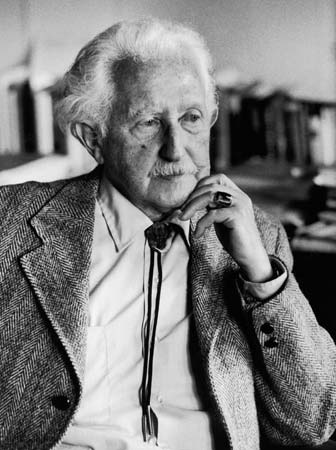
Erik Homburger Erikson (June 15, 1902 - May 12, 1994) was a developmental psychologist and psychoanalyst known for his theory on social development of human beings, and for coining the phrase 'identity crisis'.
Biography
Erikson's heritage is somewhat mysterious. His biological father was an unnamed Danish man who abandoned Erik's mother before he was born. His mother, Karla Abrahamsen, was a young Jewish woman who raised him alone for the first three years of his life. She then married Dr. Theodor Homberger, who was Erik's pediatrician, and moved to Karlsruhe in southern Germany.
The development of identity seems to have been one of his greatest concerns in Erikson's own life as well as in his theory. During his childhood, and his early adulthood, he was Erik Homberger, and his parents kept the details of his birth a secret. So here he was, a tall, blond, blue-eyed boy who was also Jewish. At temple school, the kids teased him for being Nordic; at grammar school, they teased him for being Jewish.
Erikson's greatest innovation was to postulate not five stages of development, as Sigmund Freud had done, but eight. Erikson elaborated Freud's genital stage into adolescence plus three stages of adulthood.
Major works:
- Childhood and Society (1950)
- Young Man Luther. A study in Psychoanalysis and History (1958)
- Gandhi's Truth: On the Origin of Militant Nonviolence (1969)
- Adulthood (Edited book, 1978)
- Vital Involvement in Old Age (with J.M. Erikson and H. Kivnick, 1986)
- The Life Cycle Completed (with J.M. Erikson, 1997)
Collections:
- Identity and the Life Cycle. Selected Papers (1959)
- A Way of Looking at Things: Selected Papers 1930-1980 (Editor: S.P. Schlien, 1995)
- The Erik Erikson Reader (Editor: Robert Coles, 2001)
Related works:
- Identity's Architect: A Biography of Erik H. Erikson (Lawrence J. Freidman and Robert Coles, 1999)
- Erik Erikson, His Life, Work, and Significance (Kit Welchman, 2000)