



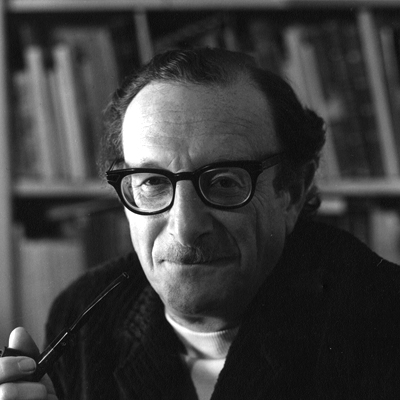
Eric Berne (May 10, 1910-July 15, 1970) was an American psychiatrist best known as the creator of Transactional analysis. He published both technical and mass market books on the subject.
Background and education
Eric was born on May 10, 1910 as Eric Lennard Bernstein in Montreal, Canada. He was the son of a physician and a writer, David and Sara Gordon Bernstein. His father died in 1921, leaving Sara with Eric and his sister, Grace. (Incidentally, Grace was five years younger than Eric.)
Bernstein attended McGill University, graduating in 1931 and earning his M.D. in 1935. While at McGill he wrote for several student newspapers using pseudonyms. He followed graduation with a residency in psychiatry at Yale, where he studied psychoanalysis under Dr. Paul Federn. He completed his training in 1938 and became an American citizen in 1939. In 1943 he changed his legal name to Eric Berne.
Clinical work
Berne's training was interrupted by World War II and his service in the Army Medical Corps. After working at Bushnell Army Hospital in Ogden, Utah, he was discharged in 1945. He resumed his studies under Dr. Erik Erikson at the San Francisco Psychoanalytic Institute and practiced at Mt. Zion Hospital.
In addition to technical papers on pschoanalysis, Berne published The Mind in Action in 1947. He became a group therapist attached to several hospitals in San Francisco. He also began to further extend of the Ego State Model of Dr. Federn.
Dr. Berne's work began to diverge from the mainstream of psychoanalytic thought. He published his work in several technical journals, but met with largely negative reactions. His break became formal in 1949 when he was rejected for membership in the San Francisco Psychoanalytic Institute.
Intuition
Berne wrote a series of papers and articles on intuition, describing in one popular exposition his apparently uncanny ability to guess the civilian occupation of soldiers from just a few moments conversation with them. His musings on the faculty of intuition led to his groundbreaking work on transactional analysis.
Transactional Analysis
Berne mapped interpersonal relationships to three ego-states of the individuals involved: the Parent, Adult, and Child state. He then investigated communications between individuals based on the current state of each. These interpersonal interactions he called transactions; certain patterns of transactions which popped up repeatedly in everyday life he called games.
In the early 1960s he published both technical and popular accounts of his conclusions. The best-selling Games People Play made terms like scripts and tokens part of the ordinary vocabulary. His Structures and Dynamics of Organizations and Groups in 1963 examined the same analysis in a broader context than one-on-one interaction.
His seminar group from the 1950s developed the term Transactional Analysis (TA) to describe therapies based on his work. By 1964, this expanded into the International Transactional Analysis Association. While still largely rejected by the psychoanalytic community, many Psychological therapists have put his ideas in practice. Other applications have appeared in the practice of organization development consultants. By 2003 the various TA organizations boast over 15,000 world wide members.
Berne was famous for his use of ordinary, easy-to-understand words instead of psychiatric terminology.
Personal Life
While Berne's professional life was full of intellectual challenge and creative work, he was less successful in his personal life. He was married three times. His first wife was Elinor McRae. They married in 1942, had two children, and divorced bitterly in 1945. In 1949 he married Dorothy DeMass Way, by whom he also had two children before their divorce in 1964.
After his popular success, Eric married a third time, to Torre Peterson in 1967. The couple took up residence in Carmel, California where he wrote, but he continued some clinical work in San Francisco. This marriage also ended in divorce in early 1970. Dr. Berne died suddenly of a heart attack on July 15, 1970.