



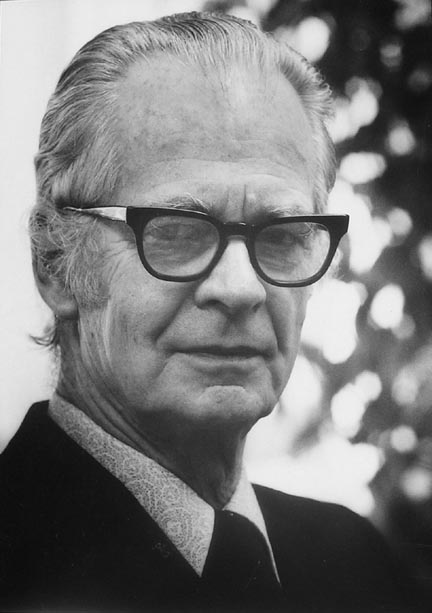
Burrhus Frederic Skinner (March 20, 1904 – August 18, 1990) was an American psychologist and author. He conducted pioneering work on experimental psychology and advocated behaviorism, which seeks to understand behavior as a function of environmental histories of reinforcement. He also wrote a number of controversial works in which he proposed the widespread use of psychological behavior modification techniques (primarily operant conditioning) in order to improve society and increase human happiness.
Life:
Skinner was born in rural Susquehanna, Pennsylvania. He attended
Hamilton College in New York with the intention of becoming a writer
and received a B.A. in English literature in 1926. After graduation,
he spent a year in Greenwich Village attempting to become a writer
of fiction, but he soon became disillusioned with his literary skills
and concluded that he had little world experience and no strong
personal perspective from which to write. During this time, which
Skinner later called "the dark year," he chanced upon
a copy of Bertrand Russell's Philosophy in which Russell discusses
the behaviorist philosophy of psychologist John B. Watson. At the
time, Skinner had begun to take more interest in the actions and
behaviors of those around him, and some of his short stories had
taken a "psychological" slant. He decided to abandon literature
and seek admission as a graduate student in psychology at Harvard
University (which at the time was not regarded as a leading institution
in that field).
Skinner received a Ph.D. from Harvard in 1931 and remained at that institution as a researcher until 1936. He then taught at the University of Minnesota at Minneapolis and later at Indiana University at Bloomington before returning to Harvard as a tenured professor in 1948. He remained there for the rest of his career.
Read more about: